
Indonesian State Firm DSI Denies Plan to Become Sole Exporter of Coal, Palm Oil and Ferroalloy, Says Its Role Is Price Verification, Not Trading
JakartaHits.id – Danantara Indonesia, the country’s sovereign wealth fund formally known as Badan Pengelola Investasi Daya Anagata Nusantara, is tightening oversight of exports of three strategic commodities — coal, crude palm oil and ferroalloy — through its subsidiary, PT Danantara Sumberdaya Indonesia, or DSI.
The oversight push is meant to ensure export prices match international market rates and are not manipulated through under-invoicing, in which exporters report a shipment’s value on customs paperwork below its actual transaction value, or transfer pricing, in which affiliated companies set internal prices to shift profits across borders.
Indonesian officials say both practices have persisted for decades, causing foreign-exchange earnings and state revenue to leak out of the country. If curbed, proceeds from natural resource exports are expected to flow back into Indonesia’s domestic financial system instead of being held offshore.
Before DSI’s creation, coal, crude palm oil and ferroalloy exports were handled directly by individual companies under the supervision of Indonesia’s Directorate General of Customs and Excise, known locally as DJBC, and independent surveyors including Surveyor Indonesia and Sucofindo. DJBC’s role centers on processing export documents and customs duties, while the surveyors physically verify goods and issue a Surveyor Report before shipment.
Neither DJBC nor the surveyors, however, were specifically tasked with comparing export transaction prices against fair market benchmarks to detect under-invoicing. That gap is what DSI was created to fill. The company began operating June 1, 2026, under Government Regulation No. 24 of 2026 on the Governance of Strategic Natural Resource Commodity Exports.
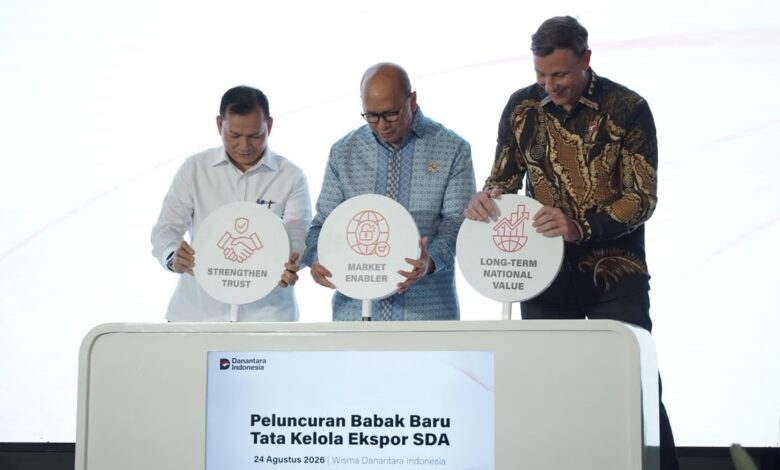
Indonesia’s Minister of Investment and Downstream Industry, Rosan Roeslani, who also serves as chief executive officer of Danantara Indonesia, reaffirmed DSI’s mandate at an event called the Launch of a New Chapter in Natural Resource Export Governance, held at Danantara Indonesia’s Jakarta headquarters, known as Wisma Danantara Indonesia.
“DSI’s purpose is not to add another layer of bureaucracy or to replace the role of the regulator. All licensing, regulatory and supervisory functions remain with the relevant ministries and agencies,” Roeslani said Monday, August 24, 2026.
How DSI’s Business Model Works
DSI’s rollout is split into two phases. During a transition period running from June 1 through December 31, 2026, companies continue exporting coal, crude palm oil and ferroalloy directly to buyers as before, but must report every export transaction to DSI. In parallel, DSI is building a data verification system to analyze those transactions — covering quantity, quality, product classification and price — so that transactions showing signs of under-invoicing can be separated from those that appear legitimate.
The second phase is scheduled to take full effect January 1, 2027. Earlier plans had circulated suggesting DSI would become a sole exporter, buying commodities from domestic producers and reselling them on international markets. Since mid-August 2026, however, Roeslani has said the government never intended DSI to be a sole exporter and that exporters will continue transacting directly with overseas buyers. DSI’s role is instead positioned as a price verifier, comparing prices reported by exporters against international benchmark prices, particularly for long-term contracts whose pricing terms have not been finalized.
Danantara Indonesia has described DSI as an entity focused on governance and business confidence rather than profit from buying and selling commodities. Officials say its success will be measured by business certainty and the trust of trading partners, not revenue targets tied to trading margins — though DSI will still apply a cost-recovery mechanism to cover its own operating expenses.
One question remains unresolved: whether DSI’s role will stay limited to verification, or whether it will evolve into a direct market participant, as suggested by a provision in Government Regulation No. 24 of 2026 stating that from 2027, exports of these commodities may only be conducted through a state-owned export company, or BUMN Ekspor. Capital-market analysts and the public are still awaiting clarity on that point. (*)